|
Invited Talks and Courses |
OFC 2023: Is Intelligence the Answer to Deal with the 5 V's of Telemetry Data? |
Telemetry data and big data share volume, velocity, variety, veracity and value characteristics. We propose a distributed telemetry architecture and show how intelligence can help dealing with the 5 V's of optical networks telemetry data. |
ECOC 2021: Applications of Machine Learning for Network Control |
Decision making needs to be moved toward the optical nodes and subsystems, so they can adapt dynamically the capacity to the actual needs and thus reduce operational costs
in terms of energy consumption. To achieve this, several technological challenges need to be addressed. In this talk, I presented the autonomous operation of Digital
Subcarrier Multiplexing (DSCM) systems, which enable the transmission of multiple and independent subcarriers (SC). |
OFC 2021: How intent-based networking can be embedded within transport optical networks |
Deployment of business intent across the optical network through policies for automated management is introduced through illustrative examples spanning from connection provisioning, dynamic network adaptation, and connection degradation and failure localization. |
Operators' network management continuously measure network health by collecting data from the deployed network devices; data is used mainly for performance reporting and diagnosing network problems after failures, as well as by human capacity planners to predict future traffic growth. Typically, these network management tools are generally reactive and require significant human effort and skills to operate effectively. As optical networks evolve to fulfil highly flexible connectivity and dynamicity requirements, and supporting ultra-low latency services, they must also provide reliable connectivity and increased network resource efficiency. Therefore, reactive human-based network measurement and management will be a limiting factor in the size and scale of these new networks. Future optical networks must support fully automated management, providing: |
The role of monitoring and data analytics in the control and management plane of metropolitan networks was presented. |
OFC 2017: Data Analytics to Support Telecom Cloud Self-Adaptation |
Three use cases will be presented where the use of data analytics helps to improve the network performance: i) Traffic prediction that is used to reconfigure the VNT topology for the next traffic conditions; ii) Techniques to detect traffic anomalies in packet networks; and iii) Localization of failures in the optical layer. |
ACP 2016: Towards Next Generation Optical Networks: Evolution and Challenges |
Three use cases will be presented where the use of data analytics helps to improve the network performance: i) Traffic prediction that is used to reconfigure the VNT topology for the next traffic conditions; ii) Techniques to detect traffic anomalies in packet networks; and iii) Localization of failures in the optical layer. |
ONDM 2016: Workshop on Big Data for networking: opportunities, challenges, and requirements |
Telecom operators are starting the deployment of Content Delivery Networks (CDN) to better control and manage video contents injected into the network. Cache nodes placed close to end users can manage contents and adapt them to users' devices, while reducing video traffic in the core. By adopting the standardized MPEG-DASH technique, video contents can be delivered over HTTP. Thus, HTTP servers can be used to serve contents, while packagers running as software can prepare live contents. This paves the way for virtualizing the CDN function. In this invited talk, a CDN manager is proposed to adapt the virtualized CDN function to current and future demand. A Big Data architecture, fulfilling the ETSI NFV guidelines, allows controlling virtualized components while collecting and pre-processing data. Optimization problems minimize CDN costs while ensuring the highest quality. Re-optimization is triggered based on threshold violations; data stream mining sketches transform collected into modelled data and statistical linear regression and machine learning techniques are proposed to produce estimation of future scenarios. |
OFC 2016: Design and Re-optimization algorithms for Elastic Optical Networks |
In this tutorial, a comprehensible overview to design and re-optimization algorithms for Elastic Optical Networks is provided; examples of on-demand capacity increment and in-operation planning are presented. An extended network live-cycle and a management architecture are eventually presented. |
ECOC 2013: Solving Routing and Spectrum Allocation Related Optimization Problems |
In this tutorial I focused on RSA. Starting from the very basics ILP models for RSA, I went through the solving techniques, such as heuristics and large scale optimization, for more complex RSA problems. An exact Dijkstra-based algorithm to solve the RSa for a single demand was also introduced. After that, advance RSA topics, such as re-optimization, elasticity, bulk-path computation, and recovery were covered. To finalise, planning and dynamic operation of flexgrid networks were introduced as examples. |
Photonics in Switching 2013: Software defined + elastic optical networks =? |
In this workshop I gave a talk regarding planning and dynamically operating flexgrid networks. In those networks the amount of lightpaths might increase significantly as a consequence of the finer granularity in the use of the optical spectrum. Different spectrum bandwidth can be allocated to each lightpath as a function of, among others, the bitrate amount to be conveyed and the modulation format used. As result, spectrum fragmentation might appear leading to non-optimal resource utilization. In addition, a failure in a fibre link could trigger hundreds, or even thousands, of path computations requests to a centralized Path Computation Element (PCE). Latter examples can benefit from using the new control plane architectures, based on the concept of SDN, currently in the process of standardization in the IETF to enhance PCE computation capabilities. |
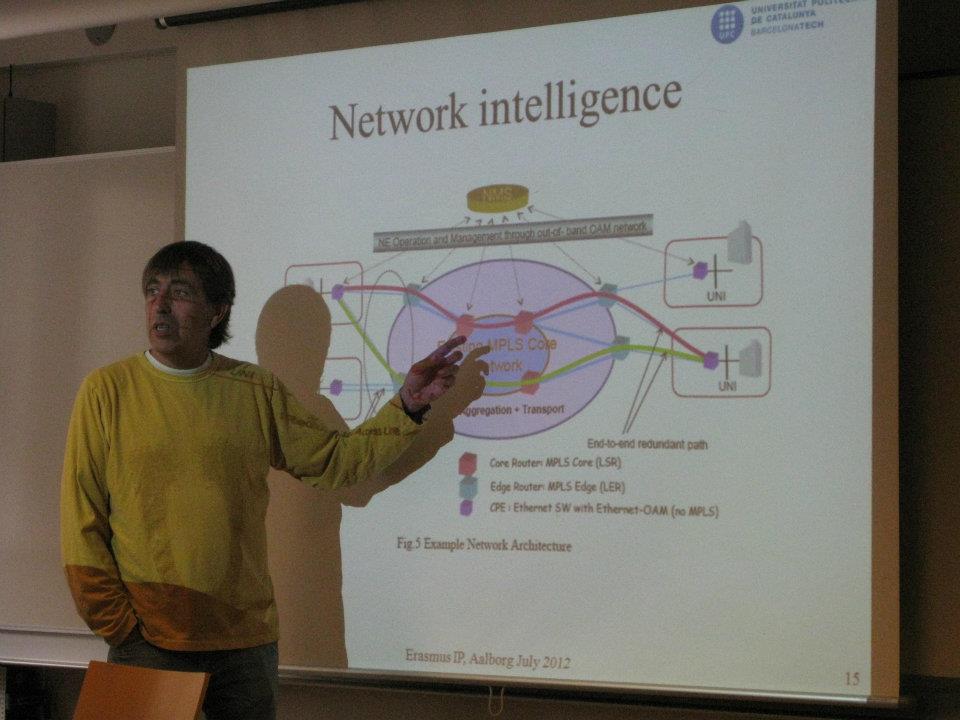
Erasmus Intensive Program on Future Broadband Infraestructures | |||
Four universities across Europe participate in this project-oriented summer school (Denmark, Poland, Latvia, Spain). Three editions have been prepared, lasting for 2 weeks from 2012 till 2014. The first edition took place in Aalborg (Denmark) in July 2012, the second edition in Bydgoszcz (Poland) in July 2013, and the last one will be held in Barcelona in 2014. | |||
|